Cost of Driving from NYC to Santa Rosa, CA in 2026
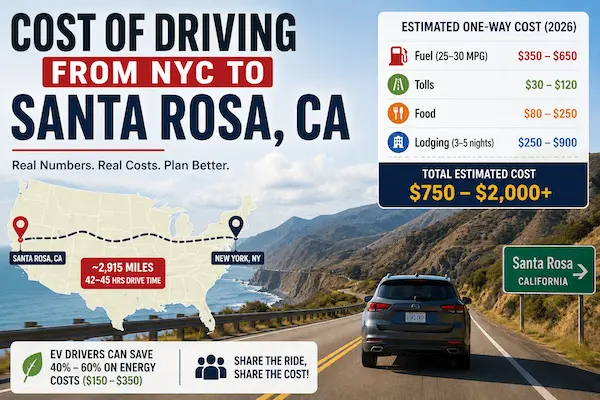
Driving from New York City to Santa Rosa, California in 2026 is a major cross-country road trip covering approximately 2,915 to 2,920 miles and requiring about 42 to 45 hours of driving time, not including rest stops or overnight stays.
For a typical gasoline vehicle averaging 25–30 mpg, fuel consumption will range from roughly 97 to 117 gallons for the one-way journey. With average U.S. gas prices expected to remain between $3.50 and $5.00 per gallon across different states, most drivers can expect to spend approximately $350 to $650 on fuel alone.
Vehicles with lower fuel efficiency, such as large SUVs and pickup trucks, may spend $550 to $900+ on gasoline. Travel cost calculators estimate a one-way fuel cost of about $614 for a vehicle averaging 25 mpg under higher fuel-price scenarios.
Additional road trip expenses should also be considered. Tolls on common interstate routes can add $30 to $120, while food costs typically range from $80 to $250 per traveler. Most drivers require 3 to 5 hotel nights, adding approximately $250 to $900 depending on accommodation choices. As a result, the total cost of driving from NYC to Santa Rosa in 2026 generally falls between $750 and $2,000+, depending on vehicle type, fuel prices, lodging preferences, and the number of travelers sharing expenses.
Travelers driving electric vehicles (EVs) can often reduce energy costs significantly. Depending on charging networks and charging habits, EV charging expenses for the same route are typically $150 to $350 one way, making electric travel potentially 40% to 60% cheaper than gasoline-powered vehicles on this cross-country journey.
For most travelers in 2026, a realistic budget for a one-way NYC-to-Santa Rosa road trip is approximately $900 to $1,500, including fuel, tolls, meals, and lodging, while families sharing costs can reduce the per-person expense considerably.
Is it cheaper to fly or drive to Santa Rosa, CA from NYC in 2026?
For most travelers in 2026, flying from New York City to Santa Rosa, California is significantly cheaper and much faster than driving, especially for solo travelers and couples. The trip covers approximately 2,915 miles, requiring about 42 to 45 hours of driving time and several overnight stops. A one-way flight from NYC to Santa Rosa or nearby Bay Area airports typically costs $180 to $500 when booked in advance, with total travel time averaging 7 to 10 hours, including connections and airport procedures.
Driving, on the other hand, involves much more than fuel costs. A vehicle averaging 25–30 mpg will use approximately 97–117 gallons of gasoline, resulting in fuel expenses of around $350 to $650 one way. Add $30 to $120 in tolls, $80 to $250 for meals, and $250 to $900 for 3–5 hotel nights, and the total road-trip cost can easily reach $750 to $2,000+. For a single traveler, flying can cost hundreds of dollars less while saving nearly two full days of travel time.
However, driving becomes more economical when costs are shared among multiple passengers. A family of four traveling together may spend $900 to $1,400 total by car, which can work out to $225 to $350 per person. Comparable airfare for four travelers could range from $720 to $2,000+, making driving competitive for larger groups. Travelers who want flexibility, sightseeing opportunities, or to transport extra luggage may also find the road trip worthwhile despite the higher overall expense.
In 2026, the general rule is simple: flying is usually the cheaper and smarter choice for one or two travelers, while driving can become cost-effective for families or groups sharing fuel, lodging, and meal expenses. For most people focused on saving both money and time, flying from NYC to Santa Rosa remains the better value.
How do I save money in toll charges from NYC to Santa Rosa, CA in 2026
If you’re planning to drive from New York City to Santa Rosa, California in 2026, reducing toll expenses can save a meaningful amount of money over a 2,900+ mile cross-country trip. Depending on your route, toll charges can range from $30 to $120 or more one way, but strategic planning can cut those costs by 50% or more.
One of the easiest ways to save money is to use a navigation app with the “Avoid Tolls” option enabled. Instead of using toll-heavy roads such as the New Jersey Turnpike, Pennsylvania Turnpike, and parts of the Ohio Turnpike, many drivers choose alternative interstate highways like I-80, which offers long toll-free stretches across Pennsylvania and the Midwest. While these routes may add 30 minutes to 2 hours to the overall journey, they can reduce toll expenses by $20 to $80.
Using an E-ZPass is another effective way to lower costs. Many toll roads offer discounted electronic rates that are 10% to 40% cheaper than cash or pay-by-mail pricing. On a cross-country trip, those discounts can save $5 to $30 without changing your route. Avoiding major metropolitan areas during peak travel periods can also help, as some express lanes and congestion-priced routes carry higher fees.
Travelers should compare the value of toll roads against fuel and time savings. In some cases, paying an extra $15 to $30 in tolls may shorten the trip by several hours and reduce fuel consumption caused by stop-and-go traffic. However, for budget-focused travelers, combining toll-free interstate routes, electronic toll discounts, and careful route planning can keep total toll costs near $20 to $50, compared with $80 to $120+ on the fastest toll-heavy routes.
For most 2026 road trippers, the cheapest strategy is to use I-80 and other toll-free interstates whenever practical, carry an E-ZPass, and avoid unnecessary express lanes, potentially saving $50 to $100 on a round trip between NYC and Santa Rosa.
Related Routes from New York City:
Cheapest Way to Drive from NYC to Detroit MI
NYC to Frisco, TX Cost of Driving and Save Money on Tolls
EV Charging Cost Vs Gas Cost for Car Driving from NYC to Santa Rosa, CA in 2026
The drive from New York City to Santa Rosa, California covers approximately 2,915 miles, making energy costs one of the largest expenses on the trip. In 2026, an electric vehicle (EV) typically consumes 27–32 kWh per 100 miles, meaning the journey requires roughly 790–930 kWh of electricity.
Drivers who start with a full battery and use a mix of home charging and lower-cost public chargers can expect to spend approximately $180 to $350 on charging for the one-way trip. Those relying mostly on premium DC fast chargers along the route may spend closer to $300 to $500.
A gasoline-powered vehicle averaging 25–30 mpg will require approximately 97–117 gallons of fuel to cover the same distance. With average U.S. gasoline prices in 2026 expected to range from $3.50 to $5.00 per gallon depending on the state, fuel costs typically fall between $350 and $650 one way. Larger SUVs, trucks, and less fuel-efficient vehicles may spend $700 to $1,000+ on gasoline for the trip.
For most travelers, EVs provide a clear cost advantage. A well-planned electric road trip can reduce energy expenses by 40% to 60% compared with a comparable gas-powered vehicle. For example, an EV spending $250 on charging versus a gasoline car spending $550 on fuel would save about $300 on a one-way journey. On a round trip, those savings can exceed $600, helping offset charging stops and travel time.
In 2026, the typical one-way energy cost from NYC to Santa Rosa is approximately $180–$350 for an EV using a mix of charging options, $300–$500 for primarily fast-charging EV travel, and $350–$650 for a gasoline vehicle. While gas vehicles may offer quicker refueling stops, EVs remain the more economical choice for drivers focused on minimizing long-distance travel costs across the United States.