Driving Time/Duration and Cost of Driving from NYC to Jackson MS in 2026
There’s a particular kind of restlessness that sets in around hour fourteen of a New York-to-Mississippi drive — somewhere past Knoxville, when the mountains have flattened out and the radio starts catching gospel stations instead of classic rock. The full route runs about 1,195 miles down through Pennsylvania, Virginia, Tennessee, and Alabama before you cross into Mississippi, and nonstop it’s a brutal 19 hours behind the wheel.
Nobody sane does it in one push. Split it with a night in Chattanooga — almost exactly the halfway mark, and worth an actual stop rather than just a bed — and you’re looking at two long but manageable days instead of one miserable one.
What I didn’t expect, plotting this trip out for 2026, was how much the year itself would matter to the budget. Gas has been on a wild ride since the Strait of Hormuz tensions flared up in the spring, pushing the national average from under $2.85 in January to $4.15 by early September — the kind of swing that makes last year’s road-trip math useless.
Run the numbers for a standard sedan getting 30 mpg and you’re burning through roughly 40 gallons, which comes out to about $166 in fuel alone; a midsize SUV at 24 mpg runs closer to $207. Add a hotel night, food for the road, and you’re realistically all-in around $350 to $420 for two people in a sedan — more like $450-plus if you’re hauling a bigger vehicle.
Here’s the trick nobody tells you: Mississippi has quietly stayed one of the cheapest states in the country for gas all year, sitting in the high $3.70s while New York idles up near $4.40 or more. So don’t top off your tank before you leave the city — let it ride down through New Jersey and into Pennsylvania, where prices already drop, and don’t fill up again until you’re well south, ideally in Tennessee or right after you cross into Mississippi itself. It sounds like a small thing, but treating your fuel stops as a strategy instead of an afterthought is the difference between paying New York prices for a trip through the cheapest gas in America, and actually taking advantage of it.
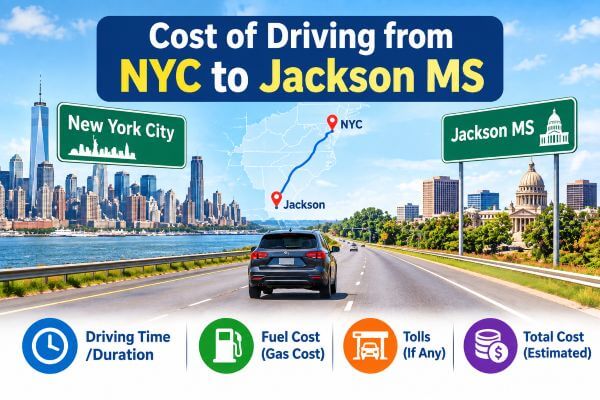
Tolls Cost from NYC to Jackson MS and How to Save Money In It in 2026?
Here’s the toll truth nobody mentions until you’re stuck in the E-ZPass lane wondering why your wallet feels lighter: leaving Manhattan is where almost all your toll money disappears. Cross the George Washington Bridge or duck through the Lincoln Tunnel and you’re already out $14 to $17 with E-ZPass, more if you’re paying cash or getting billed by mail, which runs close to double. From there, most drivers instinctively stick to I-95 south — through the full length of the New Jersey Turnpike (around $18-21), a toll plaza in Delaware (roughly $4-5), and then Maryland’s stretch through Baltimore, which tacks on another $8-12 at the Fort McHenry Tunnel and JFK Highway plaza. Add it up and you’re looking at $45-50 one way just to clear the DC area, before you’ve even crossed into Virginia.
I learned the better way on a trip I almost regretted planning the “obvious” route for: once you’re out of the city, cut west on I-78 toward Harrisburg and pick up I-81 south instead of continuing down I-95. It threads through the Shenandoah Valley, through Virginia and Tennessee, and it’s essentially toll-free the entire way — no Delaware plaza, no Maryland tunnels, nothing meaningful until you’re deep into the South, where Alabama and Mississippi don’t really toll interstates at all.
You add maybe 20-30 minutes to the total drive time, but you cut your one-way toll bill down to just that initial Hudson crossing — call it $14-17 instead of $45-50. Round trip, that’s the difference between paying $90-100 in tolls and paying $28-34.
If you’re renting the car or driving your own without a transponder, get an E-ZPass before you leave — even a temporary one from a rental company — because tolls-by-mail rates on bridges like the GWB run nearly double, and that gap alone can eat the savings from taking the smarter route in the first place.
My real rule of thumb after driving this corridor more than once: the fastest-looking route on a map is rarely the cheapest one, and for New York to Mississippi specifically, the money you save by routing around New Jersey and Maryland’s toll roads is worth more than most of the gas-price tricks people obsess over instead.
Related Routes from NYC:
Tolls and Fuel Cost Driving From NYC to Tucson AZ
Misc. Expenses When Driving from NYC to Jackson MS in 2026
Beyond gas and tolls, the costs that actually catch people off guard on this drive are food, lodging, and the small mechanical stuff nobody budgets for.
Splitting the trip over two days means one hotel night — expect $90-150 for a decent roadside spot around Knoxville or Chattanooga, less if you book a budget chain off the interstate rather than near downtown. Food for two days on the road runs $60-100 if you’re doing fast food and gas station coffee, more like $120-150 if you actually sit down for a couple of real meals.
Parking is a non-issue once you’re south of DC, but if you start from Manhattan, expect $30-50 just to get your car out of a garage before you’ve even left the city. And don’t skip a basic pre-trip check — tire pressure, oil, wiper fluid — because a $20 check at a shop beats a $150 roadside tire replacement in rural Tennessee at 11pm.
The wildcard nobody plans for is weather and construction delays, both very real on a route this long. Summer thunderstorms through Tennessee and Alabama can add an hour or two if you’re driving through the afternoon, and I-81’s Virginia stretch is almost perpetually under some kind of construction, which slows traffic more than it should for a highway that long.
Budget an extra $20-30 for snacks and drinks you’ll inevitably buy at gas stations out of boredom or bad planning, and if you’ve got a pet or kids, factor in the extra stops that add both time and small purchases along the way. All told, plan for $150-250 in miscellaneous costs beyond gas and tolls — and pad your timeline by a couple of hours so an unexpected slowdown doesn’t turn a planned overnight stop into a stressed-out late arrival.