Driving Distance & Time from NYC to Dallas, TX
Explore the 2026 cost of driving from NYC to Dallas, TX — including fuel costs, tolls, rest stops, route options, parking, and budgeting tips for this cross-country road journey.
Driving from New York City to Dallas, Texas covers approximately 1,550 to 1,680 miles, depending on the route chosen. The most efficient and commonly used route is I-78 → I-81 South → I-40 West → I-30 West → I-20 West, bypassing heavy East Coast congestion. The trip typically requires 24 to 27 hours of driving time. Many travelers spread this over 3 to 4 days for rest and comfort.
Key Points:
- Distance: 1,550–1,680 miles
- Driving time: 24–27 hours
- Recommended route: I-81 → I-40 → I-30 → I-20
Total Cost of Driving This Route
The total cost of driving from NYC to Dallas in 2026 typically ranges between $300 and $580, depending on your vehicle’s fuel efficiency, toll usage, fuel prices, and travel habits. Fuel remains the main expense. Efficient vehicles and toll-avoiding routes dramatically cut the overall cost.
Key Points:
- Estimated total cost: $300–$580
- Fuel is the largest share of cost
- Minimizing tolls and efficient fuel use saves money
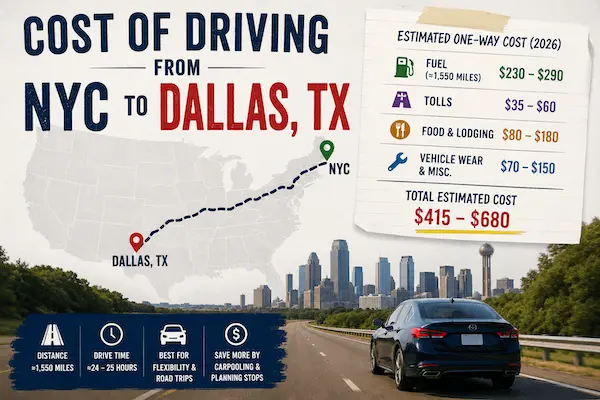
Fuel Cost Breakdown for Driving from NYC to Dallas TX in 2026
Fuel costs are the largest direct expense when driving from NYC to Dallas, TX in 2026. The journey covers approximately 1,550 to 1,560 miles one way and requires about 62 to 65 gallons of gasoline for a vehicle averaging 24 to 25 MPG. With average U.S. gas prices ranging from $4.10 to $4.20 per gallon during 2026, most drivers can expect to spend between $255 and $275 on fuel for the trip.
Drivers of fuel-efficient hybrid vehicles may spend closer to $180 to $220, while larger SUVs, pickup trucks, and vehicles with lower fuel economy could see fuel expenses exceed $350.
For travelers planning a NYC to Dallas road trip, fuel budgeting is essential because gasoline prices vary across states along the route. A typical fuel cost breakdown includes $255–$275 for regular gasoline, based on average fuel efficiency and current gas prices.
Vehicles achieving 30 MPG or better can reduce fuel costs by approximately 15% to 25%, while vehicles averaging 18 to 20 MPG may require over 80 gallons of fuel and spend $330 to $380. For a round-trip drive between New York City and Dallas, travelers should budget approximately $510 to $550 for fuel, making gasoline the single largest transportation expense on the journey.
Assuming a 2026 average fuel price of $4.20 per gallon, here’s an estimate based on mileage (~1,620 miles average):
| Vehicle MPG | Gallons Needed | Estimated Fuel Cost |
|---|---|---|
| 20 MPG | ~81 gallons | ~$340 |
| 25 MPG | ~65 gallons | ~$273 |
| 30 MPG | ~54 gallons | ~$227 |
| 50 MPG (Hybrid) | ~32 gallons | ~$135 |
Key Points:
- Typical fuel cost: $227–$340
- Hybrid vehicles substantially reduce fuel expenses
- Large SUVs/trucks consume more fuel and increase cost
Gas Prices Along the Route (Area-Wise Comparison)
Gas prices vary considerably along the route from NYC to Dallas, TX, giving road trippers opportunities to reduce fuel expenses by choosing where to refuel. In 2026, the highest gasoline prices are typically found in the Northeast.
Drivers departing New York City can expect average regular gas prices of approximately $4.45 to $4.55 per gallon, while neighboring Pennsylvania averages around $4.30 to $4.40 per gallon. As the route continues south through states such as Virginia and Tennessee, fuel prices generally decline, helping travelers lower their overall NYC to Dallas driving cost.
The most affordable fuel is usually found in the South and Texas. Tennessee averages approximately $3.80 to $3.90 per gallon, Arkansas around $3.85 to $3.95 per gallon, and Texas approximately $3.65 to $3.75 per gallon. Since the trip requires roughly 62 to 65 gallons of fuel, filling up in lower-cost states instead of New York can save drivers $40 to $60 on a one-way journey.
Strategic fuel stops in Tennessee, Arkansas, and Texas are often the most cost-effective way to reduce total road trip expenses in 2026.
Fuel prices drop gradually as you traverse from the Northeast to the Southern plains and Texas. States along the route tend to have moderate-to-low fuel prices compared to coastal zones.
| Region / State | Expected 2026 Avg Fuel Price (USD/gal) |
|---|---|
| New Jersey / Pennsylvania | $4.00–$4.20 |
| Virginia / Tennessee | $3.85–$3.95 |
| Arkansas / Louisiana border areas | $3.55–$3.70 |
| East Texas approaching Dallas | $3.45–$3.60 |
Key Points:
- Cheapest fuel: East Texas & nearby Southern states
- Most expensive fuel: Northeast corridor
- Planning fuel stops smartly can save $20–$40 overall
Mileage, Fuel Efficiency & Vehicle Type Impact
Highway miles favor fuel-efficient cars, sedans, and hybrids. Large vehicles like SUVs, trucks, or cars with heavy cargo or rooftop luggage have lower MPG — often by 10–20%. Long interstate stretches help maintain better MPG, but heavy load, air conditioning (in summer), or roof racks may reduce efficiency.
Key Points:
- Sedans/hybrids = best MPG and lowest cost
- Heavy vehicles = higher fuel consumption
- Consistent highway speed helps maximize fuel efficiency
Toll Charges on the Route (State-Wise Details)
Toll charges for driving from NYC to Dallas, TX are generally moderate compared with fuel expenses, with most toll costs occurring in the Northeast portion of the trip. In 2026, drivers can expect to pay approximately $30 to $65 in total tolls depending on the exact route, vehicle type, and payment method.
The largest toll expenses are typically associated with New York City bridges and tunnels, where passenger vehicles may pay $15 to $23, followed by toll sections in New Jersey costing approximately $5 to $12. Drivers who use an E-ZPass can often save 20% to 40% compared with toll-by-mail rates, making it the most economical option for this road trip.
After leaving the Northeast, toll expenses drop significantly. Most highways through Pennsylvania, Virginia, Tennessee, Arkansas, and much of Texas are either toll-free or have very limited toll facilities on common Dallas-bound routes.
Texas does have several toll roads around the Dallas–Fort Worth metro area, but many travelers can avoid them without adding significant travel time. As a result, budgeting $40 to $50 for tolls is realistic for most drivers making the one-way trip from NYC to Dallas in 2026.
Tolls are concentrated in the Northeast early in the route. Once you pass Virginia and Tennessee, most of the trip is toll-free on interstates leading into Texas.
| Region / Toll Road | Estimated Toll (2026) |
|---|---|
| NYC bridges/tunnels | $12–$18 |
| New Jersey Turnpike / nearby toll roads | $5–$8 |
| Pennsylvania Turnpike | $18–$30 |
| Virginia / Tennessee border toll segments | $3–$5 (rare) |
| From Arkansas to Dallas | $0 |
Total Estimated Tolls: $20–$45
Key Points:
- Tolls mostly in first 300–400 miles
- Southern states and Texas mostly toll-free
- Toll-avoidance saves money but may add 20–50 miles
Parking Costs Upon Arrival (Dallas)
Parking in Dallas tends to be more affordable than coastal cities. Costs vary depending on location and type of stay (hotel vs. downtown visit).
| Area / Stay Type | Typical Parking Cost (Per Day) |
|---|---|
| Downtown / Central Business District | $10–$25/day |
| Suburban areas / hotel stays outside core | Often free or $5–$15/day |
| Residential / long-term stay zones | Often free or low-cost |
Key Points:
- Parking rarely major expense
- Suburban/hotel parking often free — good for savings
Additional Driving Expenses (Meals, Stops, Wear & Tear, Lodging if Needed)
Long drives often include expenses beyond fuel and tolls:
- Meals for 3–4 days: $60–$140 per person
- Snacks, water, coffee: $15–$30
- Wear & tear (tires, brakes, maintenance): $20–$40
- If you break the journey: Motel stays 1–2 nights: $50–$120/night
Key Points:
- Food and lodging can add $100–$250 per person
- Wear & tear is modest but present
- Shared travel reduces per-person cost
Cheapest Time of Day & Best Season to Drive
Leaving NYC early in the morning (before 5 AM) helps avoid heavy metropolitan traffic and ensures smoother early miles. The best travel seasons are Spring and Fall—weather is generally mild and roads are clear. Summer in the South can bring heat and heavy traffic; winter may bring icy patches in the Appalachian region.
Key Points:
- Best start time: 4–6 AM
- Best seasons: Spring & Fall
- Summer heat and winter weather increase risk and fuel use
Cost Comparison: Driving vs. Flying vs. Bus/Train
| Mode | Estimated Cost | Travel Time | Comments |
|---|---|---|---|
| Driving | $300–$580 | 3–4 days | Flexible, bring luggage, scenic road trip |
| Flying | $120–$250 (one-way) | ~4.5 hours | Fast, minimal hassle, but car unavailable on arrival |
| Bus / Coach | $110–$180 | 26–32 hours | Cheapest if no car needed, longer duration |
| Train (if available partially) | $150–$250 | 30+ hours | Comfortable, slower, limited routes |
Key Points:
- Driving is best for flexibility and luggage-heavy trips
- Flying is fastest and often cheapest for solo trips
- Bus/train best for budget travelers without car needs
Budget Tips to Reduce the Overall Driving Cost
- Refuel in Arkansas or East Texas for cheapest gas
- Avoid toll roads using state highways or alternate interstates
- Travel with at least one passenger to share fuel/food costs
- Use motels outside city centers for cheaper lodging and free parking
- Pack meals/snacks instead of eating out frequently
Key Points:
- Fuel and toll savings = major cost reductions
- Smart lodging & food planning reduces overhead
- Sharing trip cost reduces per-person spending
Route Options & Road Conditions to Expect
Route 1 (Recommended / Balanced): I-81 → I-40 → I-30 → I-20 → Dallas
- Smooth highway for majority of the journey
- Avoids heavy I-95 and coastal traffic
Route 2 (Alternate Coastal / East Corridor): I-95 South → I-85 South → I-20 West → Dallas
- More traffic, especially through southern metro zones
- Slightly longer in time and distance — not ideal for cost or fuel efficiency
Road Conditions Overview:
- Appalachian region: rolling hills, occasional steep gradients
- Tennessee & Arkansas: flat plains, smooth highways
- Texas & approaching Dallas: wide lanes, good maintenance
Key Points:
- Route 1 offers best balance of mileage and road quality
- Route 2 may increase travel time and fuel use
Travel Time During Peak vs. Off-Peak Hours
Starting during peak commute hours (5–9 AM out of NYC) adds 1–2 hours due to congestion. Once past the northeastern corridor and southern Appalachians, traffic eases, allowing consistent highway-paced travel. Approaching Dallas during late afternoon/evening may meet local traffic slowdowns.
Key Points:
- Avoid leaving NYC at peak time
- Midday or late-night departures ideal
- Watch for Dallas area evening congestion
Safety Tips and Recommended Rest Stops
Frequent rest stops every 2–3 hours are advised to maintain alertness and reduce fatigue. Good rest and service points along the route include:
- Welcome Centers in Virginia and Tennessee along I-40
- Rest plazas in Arkansas and eastern Texas
- Service centers just outside Dallas before city traffic
Safety tips: check tire pressure before entering long flat plains, monitor fluid levels, take breaks every 2–3 hours, avoid nighttime mountain driving, and carry water and snacks especially in hot southern states.
Key Points:
- Rest every 2–3 hours
- Ensure vehicle maintenance before trip
- Hydration and regular breaks key for safety
Final Cost Summary of the Trip
Driving from NYC to Dallas in 2026 typically costs $300 – $580, depending on fuel efficiency, toll avoidance, and travel habits. With careful planning — using fuel-efficient vehicles, avoiding tolls, and choosing budget lodging — this journey becomes an affordable, flexible way to reach Texas with your own car.
Key Points:
- Total cost: $300–$580
- Fuel cost (typical sedan): ~$227–$340
- Tolls: $20–$45
FAQs
1. How many miles is the drive from NYC to Dallas?
About 1,550–1,680 miles depending on route.
2. How much fuel will I need?
Roughly 54–81 gallons depending on MPG.
3. Are tolls expensive on this route?
No — total toll cost usually stays between $20 and $45.
4. Which states along the way have the cheapest gas?
Arkansas and East Texas often have the lowest fuel prices on this corridor.
5. What is the best time of day to begin the drive?
Depart between 4 AM and 6 AM to avoid East Coast traffic.
Summary Table
| Topic | Summary |
|---|---|
| Distance | 1,550–1,680 miles |
| Total Cost | $300–$580 |
| Fuel Cost | ~$227–$340 (efficient car) |
| Tolls | $20–$45 |
| Parking (Dallas) | $5–$25/day |
| Best Route | I-81 → I-40 → I-30 → I-20 West |
| Best Departure Time | 4–6 AM |
| Cheapest Fuel Region | Arkansas & East Texas |